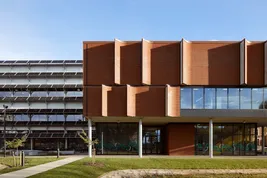




PHF Science is New Zealand's Crown Research Institute dedicated to enhancing the health, wellbeing, and safety of our communities. This new facility will feature a dynamic innovation hub alongside 1,500m² dedicated to cutting-edge laboratories and a forensic services centre. Designed as a catalyst for creating innovative products and services, the building aims to foster a collaborative environment, promoting interdisciplinary research and partnerships both within PHF Science and with external stakeholders.


This two-storey structure supports specialist PC2 (Physical Containment Level 2) laboratories and office functions with efficient floorplates, meeting the highest standards in scientific research. The state-of-the-art facility enhances PHF Science's capabilities in genomic sequencing, forensic science, and health and environmental sciences, while housing the Wellington Forensic Services Centre.
The laboratories feature open, flexible environments designed for contemporary workflows and safety compliance. These spaces maximise resource efficiency, with specialist areas tailored to specific research needs. The Innovation Hub fosters creativity and technological advancement, supporting training, teaching, and product development.
The design for the new building is the result of deep and meaningful engagement between PHF Science and Ngāti Toa Rangatira. The facility will provide a platform to further this relationship and share mātauranga (knowledge) through innovation in science and Te Ao Māori world views.
This unique co-design approach identified the importance of the Puna (the underground stream) on the site and set wai (water) at the very heart of the design. It forms the organisational backbone for the entire site, informing future masterplanning, layout of the new building and the connections, both visual and physical across the site. This also drove a building that responds strongly to the environment.
The building form itself is inspired by rau kawakawa, a resilient native plant with deep meaning for Ngāti Toa Rangatira. It symbolises regeneration, new life, and healing power.
Externally, the organic roof form mimics the kawakawa leaf and provides shelter, rainwater harvesting and solar generation. It gently drapes to touch the ground at three points marking Puna (stream), Mahau (porch) and Waka Haumi (beacon/presence) - the three cornerstones from Tāhū Kei Runga Rā (design themes).
The co-design strategies continue inside with the spatial organisation taking cue from Māori architecture, which also informs decorative elements such as the kawakawa feature ceiling in the wharekai.
The facility prioritises sustainability with systems to monitor emissions and promote energy efficiency. The project has achieved a 5 Star Green Star Design & As Built NZv1.0 Certified Design Review rating – the first laboratory building to be Green Star certified in New Zealand. The building’s solar panels, rainwater harvesting, and electric vehicle charging stations help reduce energy consumption and carbon emissions. Material selection focuses on reducing embodied carbon, while biophilic interior design enhances occupant wellbeing. Future flexibility ensures the facility adapts to evolving scientific needs.