

A question of belonging
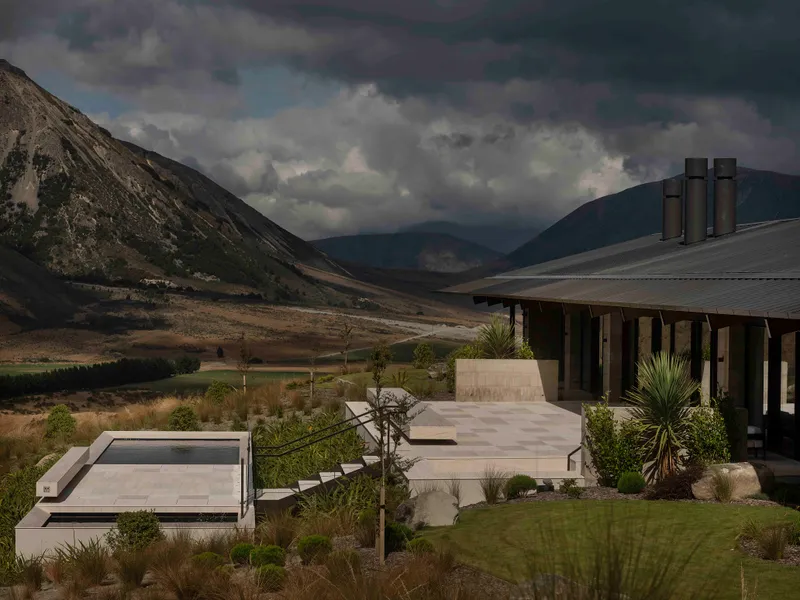
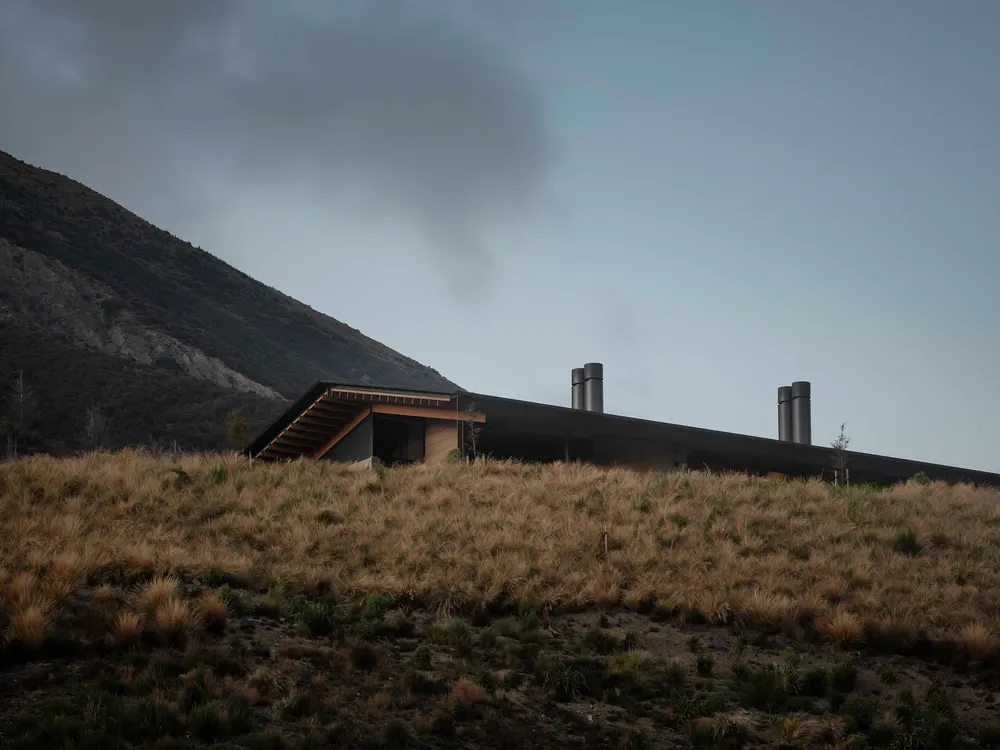
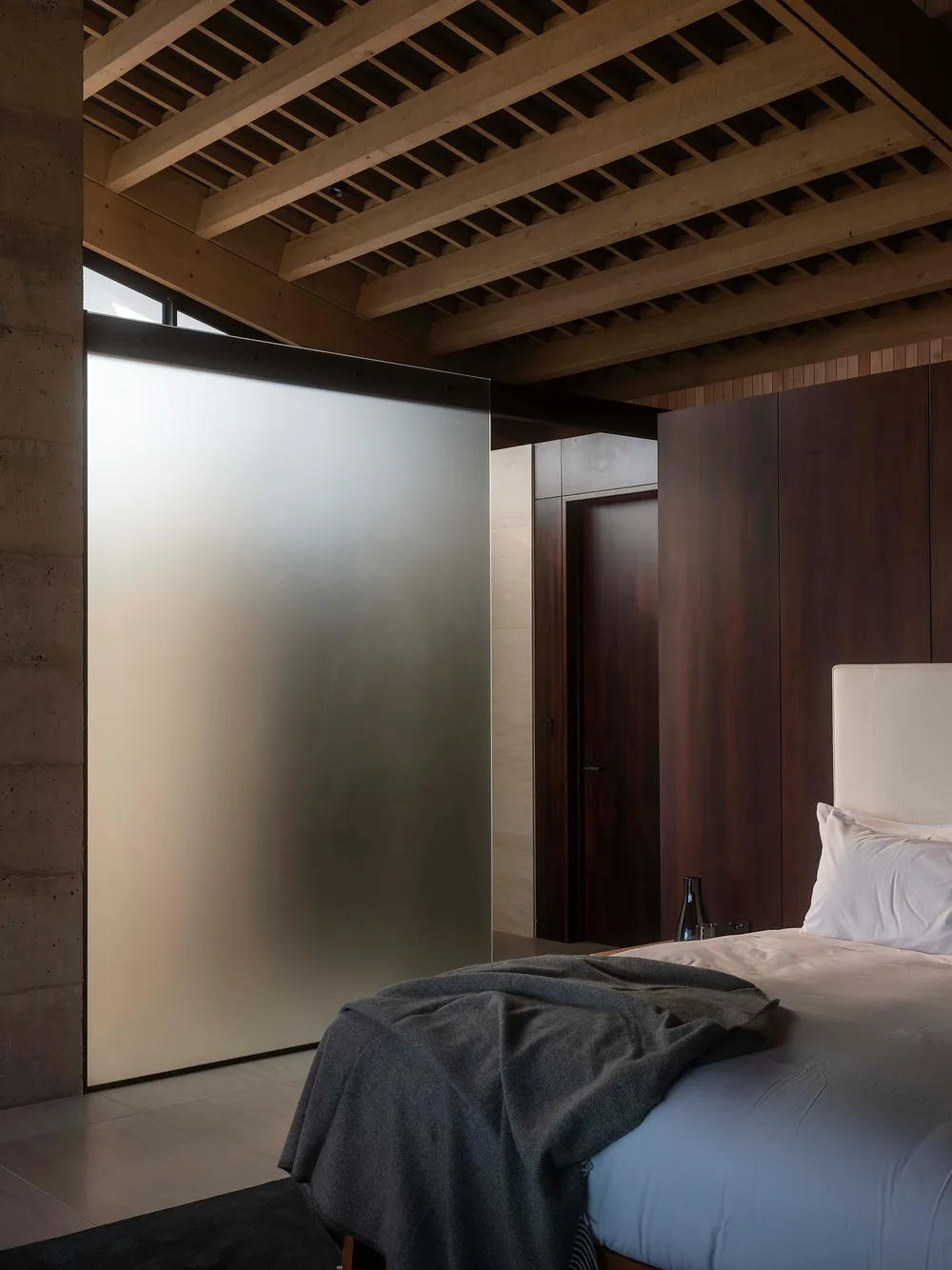
Drawn across a ridge on a working sheep station in Craigieburn Valley on Aotearoa’s South Island, Flock Hill Lodge is charged with the energy of its alpine setting. Thick, rough-cast concrete walls answer the presence of sculptural limestone outcrops that rise across the land, settling the residence against fierce winds and shifting temperatures. Above, a lattice-like gabled roof appears to hover, providing shelter while opening to the expansive sky.
The elemental palette of timber and concrete heightens the play on contrast between mass and lightness, enclosure and view. Sugarloaf Mountain looms to the north, mirrored in the glassy waters of Lake Pearson below – an improbable symmetry held in the building’s frame.
The house’s acclaim invites a deeper question: if there is a blueprint for residential architecture in Aotearoa, what qualities give it that standing? Can, and should we attempt to define them?
The question has long hovered at the edges of architectural discourse here – always open, often revisited. Its persistence may lie in architects’ reluctance to give a fixed answer. In 1984, architect and writer David Mitchell posed one possible response. In his introduction to The Elegant Shed: New Zealand Architecture Since 1945, he asserted that “among New Zealand architects, pragmatism is still the most morally defensive critical position…
But architecture is finally an art, and no amount of attention to the practicalities of shelter can replace that emotional charge that the more memorable buildings succeed in giving us. Good or bad, we recognise architecture by its ability to invade our emotional world.”
Though, four decades on, we may have moved beyond the shed as the dominant New Zealand vernacular, Mitchell’s question of emotional resonance continues to offer a more tangible entry point to the blueprint enquiry: What enables the country’s most impactful houses to build a lasting emotional connection on those who experience them, whether lived within or admired from afar?
In conversation with Jonathan Coote, Christchurch Head of Design, and Tobin Smith, Principal at Warren and Mahoney, Anna Dorothea Ker explores how these questions are being navigated in practice – and what continues to define, challenge, and inspire residential architecture in Aotearoa.
Intuition in practice
Great architecture grows from good conversation.
“It’s a relationship thing,” says Jonathan of gleaning the essence of a client’s brief. “The quickest way to drop your client’s guard is a genuine laugh;” he says. “Once the formality falls away, we get to the truth of how they live.
The most meaningful cues often surface in passing. “The walls don’t typically come down until two or three meetings in,” he notes, “then we’re sitting in their place, and someone makes a comment about the baked bean cans facing the same way in the pantry.”
He speaks of holding back the urge to draw too soon. “Deferring that so that you’ve got a good amount of time to really listen and sponge up everything they’re trying to give you – their fears and loathings and heart’s desires.” Increasingly, briefs carry more emotional content. “People want spaces that restore health and vitality, not just satisfy a checklist,” as Tobin puts it.
“Elements of retreat are definitely resonating,” adds Jonathan. “Modern life is relentless; many people ask for a home that lowers the energy the instant they walk in the door. A pull toward simpler, more analogue living is discernible; accordingly, houses are expected to provide a bulwark against the overload of the digital world. Occasionally, a single vignette inspires the design.
Modern life is relentless; many people ask for a home that lowers the energy the instant they walk in the door.
Sequencing simplicity
Moments like these become touchstones – but translating them into built form takes conviction. In early client conversations, Jonathan prefers to offer a single solution over a menu of alternatives. “An idea needs three strong legs to stand on,” he says. “If you sweep a leg off an idea and it’s only got two to stand on, it’ll topple.”
For him, the best work begins with taking a position on universal principles, associating the more functional and aspirational aspects of the brief and overlaying a simple theoretical position, a framework for the design to develop. Amongst a diverse array of opportunities in architectural theory, He has time and time returned to Gottfried Semper’s work, introduced in The Four Elements of Architecture in 1851, which identified the fundamental components that shape every dwelling: hearth, roof, enclosure and mound (platform) – with the hearth as the generative centre.
“I tend to underpin the work with a mix of those simple notions, if it suits the project,” Jonathan says. “They assist in providing a framework to answering where the centre of the house is, what its rituals are. It’s a core human memory and a simple notion of dwelling that we all can relate to at some level. We look to get clear on what and where the centre of the house, why that is and how it might be represented. Traditionally it used to be a hearth, but it’s a multiplicity of things now. Once that centre is established, how it might be used, what it feels like to occupy, how does it sound, how does it absorb or reflect light, what are its sensory experiences?
Questions like these are grappled with and responded to over long periods of time. We then craft the outcome utilising stacking, cutting, casting and tying which form a typical fundamental vocabulary alongside client desires and site specifics. It’s not a hard and fast theoretical position – but one formed through patience and practice.”
Pacing and alignment underpin Tobin’s approach. He likes to bring people into the house before opening the full panorama. “I like entering a space and looking past it, out to a piece of landscape.” Jonathan echoes the importance of sequence. “I think every house needs to understand whether you’re getting the goods early or whether there’s a bit of a tease – coming through various phases and only being given what it is that you came for at the end.”
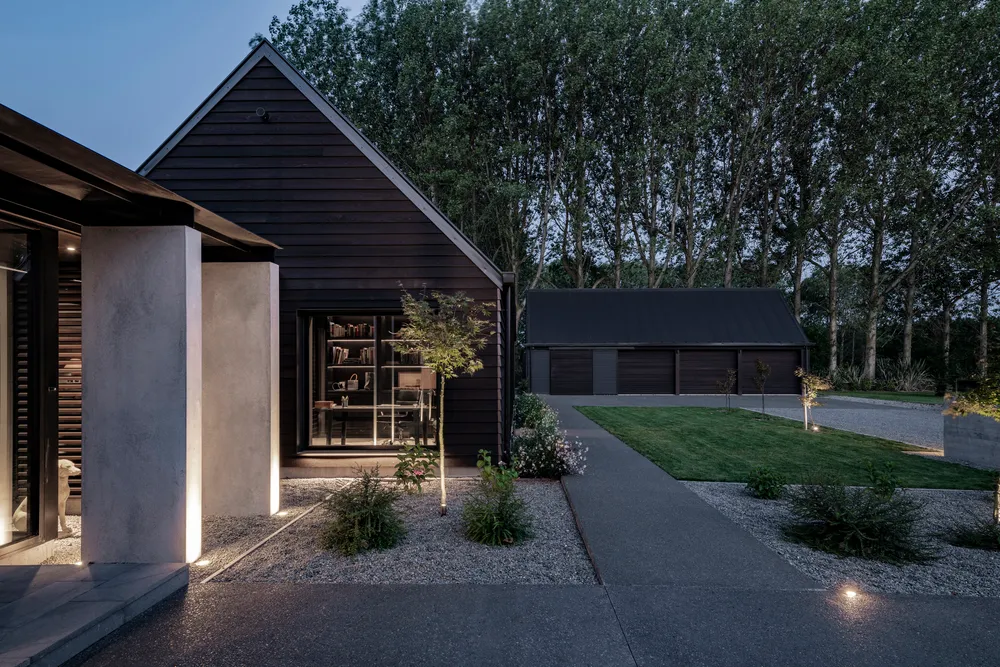
The Hepburn’s Road House embodies that anticipation. Set on a rural mid-Canterbury site with views to Mt Somers and the Southern Alps, the home nods to the region’s working landforms, weather patterns and building traditions, translating them into a language of symmetry and proportion. The home reveals itself gradually through a series of gabled pavilions, each with a distinct material identity: concrete for principal rooms, timber for secondary spaces, corrugated steel for outbuildings. Volumes are precisely placed to delay the complete panorama, drawing visitors through a progression of thresholds before the landscape fully unfolds.
“An idea needs three strong legs to stand on,” he says. “If you sweep a leg off an idea and it’s only got two to stand on, it’ll topple.”
Restless terrain
In our “really deep, long country,” that process of crafting is one of continual adjustment – designing with the shifts, the gradients, the extremes. Temperature range alone demands attentiveness, but so do slope, sun angles, seismic risk and local wind patterns. Sites resist generic solutions.
Local knowledge unlocks positioning. Sunlight, for example, behaves differently in Queenstown than it does in Christchurch. A hillside might offer panoramic views and unyielding wind in equal measure. “Wind shapes almost every New Zealand site more than the sun does, and you have to respect its power from the first sketch.” Tobin notes. “Good houses open wide in summer and hunker down in winter; that seasonal dialogue is underrated in our building code.” Knowing when to tuck in and when to open up defines liveability as much as it does character.
Then come the subtler cues: moss, rock, native vegetation. These guide choices in palette and material. Corten steel might suit one site and feel out of place on another. Timber, used elegantly, can tie a building to its place. As important as what is selected is what is left out. “Instead of throwing every material at a façade, we focus energy on a few beautiful junctions and let the rest stay modest,” Tobin notes. “Design doesn’t end at concept; two boxes might glance past each other elegantly, but only if every detail keeps them dancing, not colliding.”
Positioning a home within any given environment involves a mix of hard data – on topography, wind, sun paths, drainage, – and “a divining rod intuition” that tells you when it feels right, says Jonathan. The landscape might offer formal symmetry, as at Flock Hill, or something more elusive – but when judged correctly, the sense of fit is instinctive.
“New Zealanders respond viscerally when a building sits comfortably in our dramatic geography.”
Sense of place
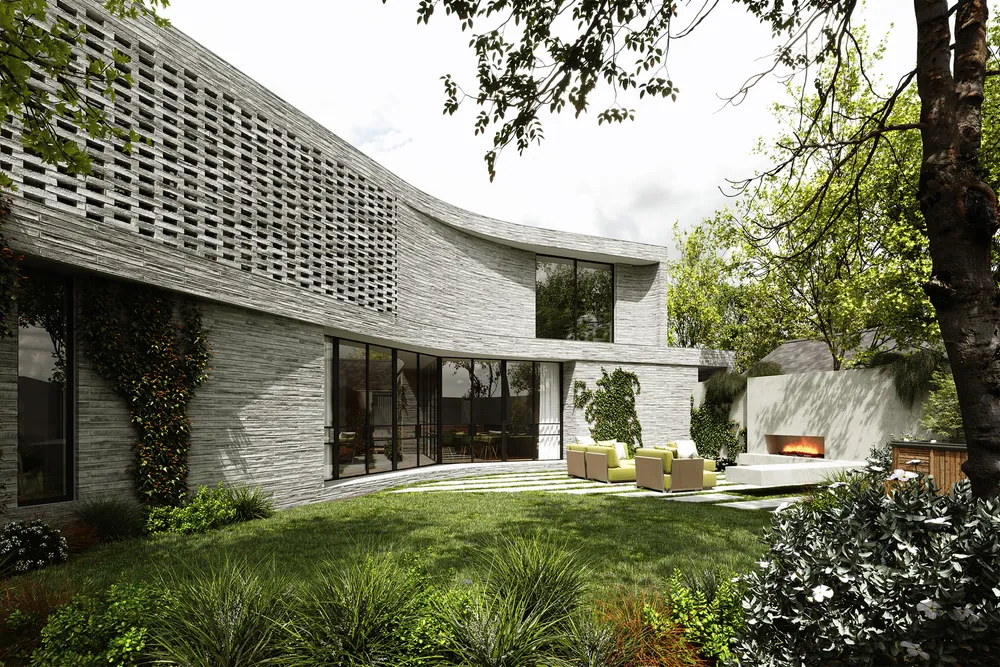
That clarity extends through the interior. Jonathan draws a line between Semper’s elemental framework and the atmospheric sensibility of Jun’ichirō Tanizaki’s ‘In Praise of Shadows’ – a meditation on light, texture and sensory nuance in traditional Japanese architecture.
Essential to this is proportion – a careful modulation of volume, with subtle shifts in light and acoustics as thresholds are crossed; a technique favoured by Sir Miles Warren. For Tobin, proportion needs to feel instinctive. “It isn’t about golden ratio maths; it’s about what feels right to the body after years of drawing and building.”
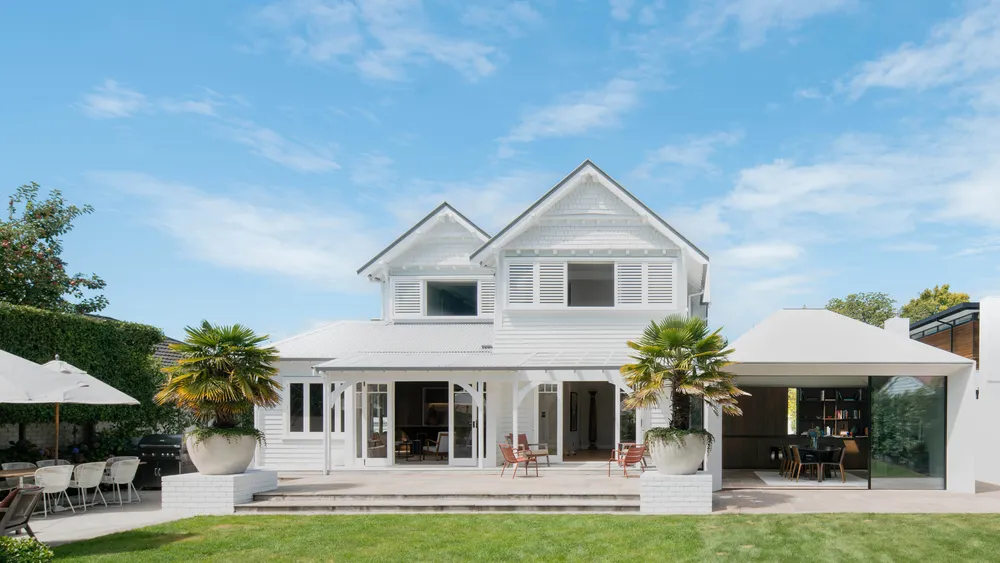
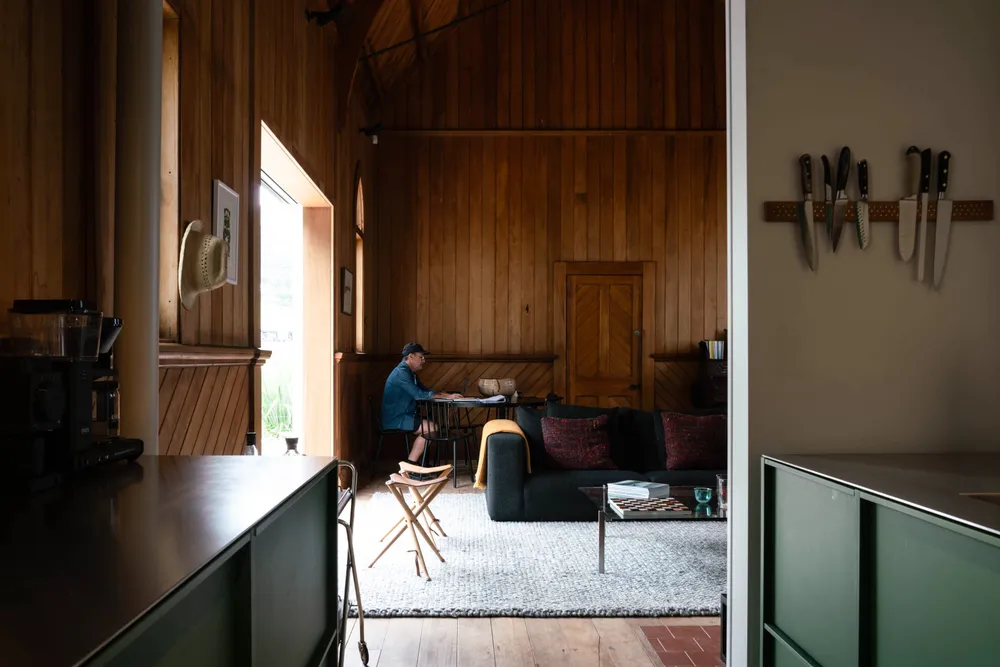
That thinking is distilled in the adaptive reuse of Wainui Church, a sharp white punctuation on the rolling Canterbury landscape. The time-weathered Presbyterian chapel was stripped back and carefully revitalised, its match-lined interior, originally crafted by shipbuilders, left largely intact. The 45-square-metre floor plan became a soaring triple-height bunk room, anchored by minimal but precise interventions: a wet room, a storeroom, and a single west-facing opening with a sliding screen that invites sunlight and a generous outdoor life.
Inside, a steel mezzanine floats off the existing structure, reached by a sculptural spiral stair leading to the primary bedroom.
A kitchen and lounge are integrated below, with the children’s room and bathroom tucked discreetly into the vestry. Material choices are expressive and unexpected, adding warmth and vibrancy to the compact volume. Fine new angles frame the original windows, while the roof insulation has been recessed to retain the slenderness of the façade.
“Design doesn’t end at concept; two boxes might glance past each other elegantly, but only if every detail keeps them dancing, not colliding.”
Designed to evolve
The work honours what came before while building toward what’s needed now. “History doesn’t weigh on us heavily,” Jonathan says of Warren and Mahoney’s formative architectural heritage. “The ability to reflect on it in a way without being overwrought, or not feel we’re repeating things just because we can. Looking at that objectively and pulling out learnings is a really powerful thing for us as practitioners.”
Sir Miles Warren shared this view. In his 2000 Architecture New Zealand ‘Gold Medal’ essay, he wrote, “We have long escaped the straitjacket of the right angle and the dictates of the structure of modernism. Complex forms and spaces, curves and diagonals are exploited, together with the materials and techniques to achieve them. There is a proliferation of choice, isms galore.”
Looking toward what lies ahead, Jonathan and Tobin are giving questions of longevity increasing attention. “We’re still learning what global warming means for residential design, so integrity and durability are our safest bets,” Jonathan says, citing early carbon counting and balancing as “one of the most invigorating parts” of his practice. “Quality is the constant we should carry into an uncertain future: durability, clarity and the capacity to adapt over decades.”
Tobin is struck by how rarely these changes are discussed at briefing stage. A home built for a couple in their thirties may need to serve very different purposes 20 years on. “What happens when the family changes? You start off with young kids, then you’ve got teenagers, they leave home – how does the house cope with that?” Building in flexibility from the outset, he suggests, would better support the full life of the home.
Beyond the blueprint
In a time of boundless possibility, Warren and Mahoney’s approach to residential architecture reveals a distinct absence of a replicable blueprint. The practice has no shortage of its own precedents, from the Dorset Street flats to Flock Hill.
Still, it resists looking back. “If we used the same process every time, it would be uninspiring for us as practitioners,” Jonathan says. “It would become mannerist.”
Certain themes do surface in service of emotional resonance – many drawn from first principles. Warren and Mahoney’s work returns to primordial techniques: Semper’s elemental framework, with its acts of cutting, casting and stacking; natural materials and clear forms; local applications of Tanizaki’s nuanced treatment of light and shadow, playful sequencing. The firm’s founders’ command of proportion and simplicity is always present.
This finely tuned toolkit, when applied to the specifics of each site and the distinct lives it holds, can only give rise to singular outcomes.
Perhaps this is what allows some of Aotearoa’s most enduring homes to emerge – premised on lasting principles, free from formula, attuned to the people it shelters and the land that holds it. A home made in this way feels like it could only be here – inseparable from its landscape, and impossible to imagine anywhere else. When a home grows from its site like this, it doesn’t just belong to the land. It allows us to feel that we, too, belong.
“Our designs bring people and place together. We create homes that are genuine reflections of their inhabitants - authentic, enduring and honest homes that are both beautiful and deeply rooted in their context.”